
The Winston Project

The Winston Project

Exploring the potential of gold and silver mineral exploration in New Mexico’s rich geological landscape

This project aims to maximize resource discovery while ensuring sustainable practices that benefit both the industry and the environment.

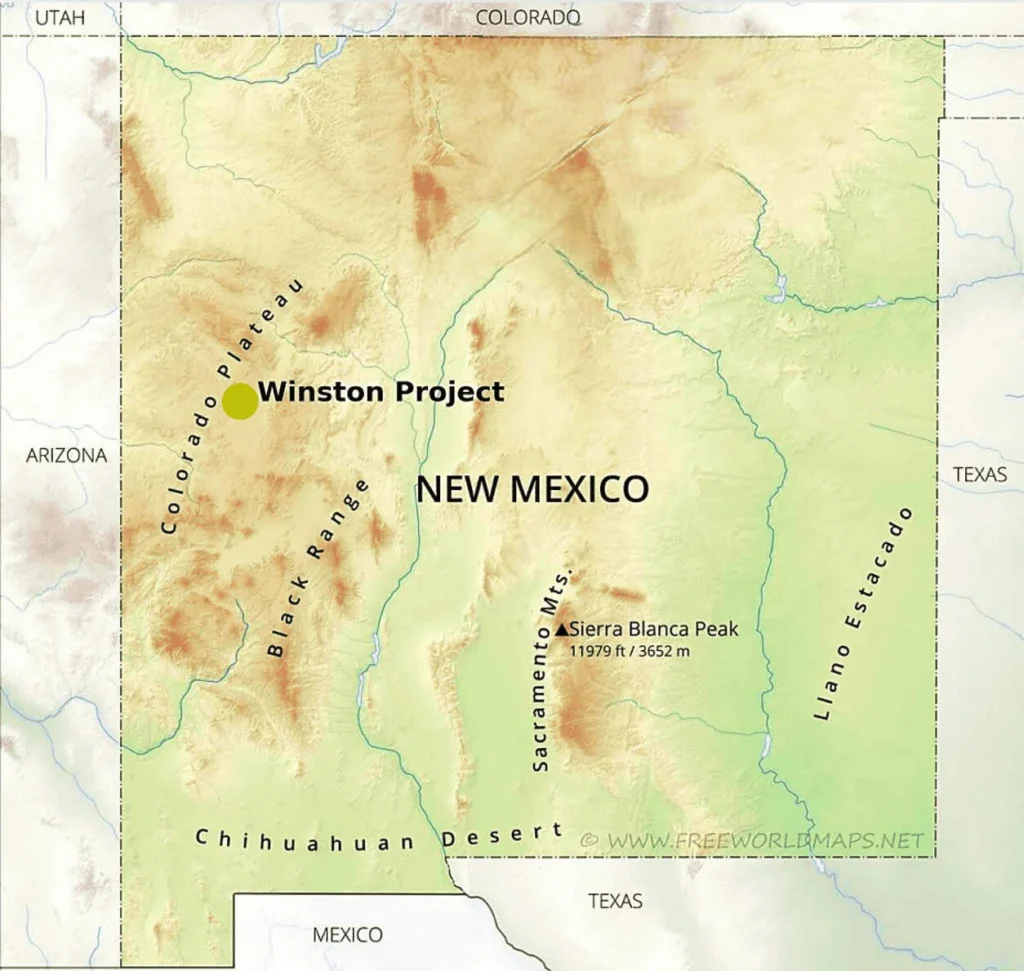
Rio Grande Resources controls a 100% interest in the Winston Group of Properties, which spans over 3,000-acres, with drill-ready sites, northwest of the town of Truth or Consequences covering the Chloride Mining District in Sierra County, New Mexico, United States. The property consists of 147 unpatented lode mining claims, including four (4) Little Granite claims and the two (2) patented mining claims in both Ivanhoe and Emporia, for a total aggregate of 149 total mining claims. The Ivanhoe, Emporia and Little Granite mines, each produced high-grade gold and silver during their full-time operations over a century ago, with Little Granite producing high value ore from some of its underground shoots.

Recent Exploration Success

Since becoming a standalone public company, Rio Grande has undertaken a systematic exploration strategy designed to evaluate, expand, and prioritize mineralized targets across Winston.

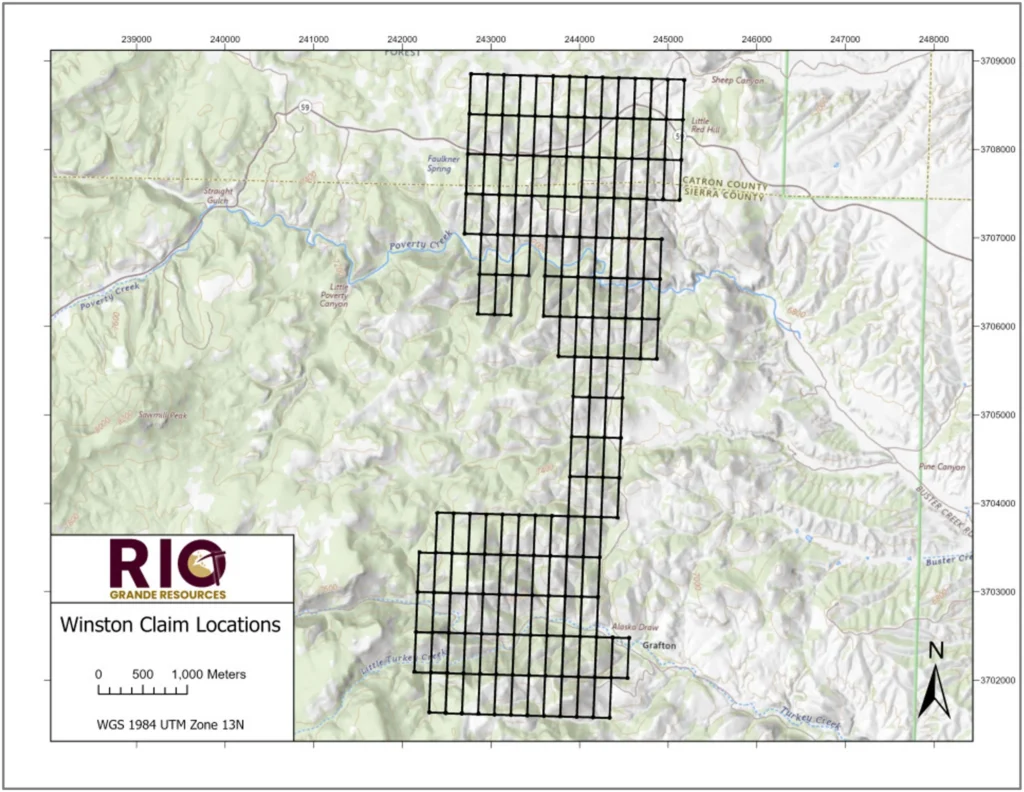
The Company announced the engagement of Dahrouge Geological Consulting Ltd. (“Dahrouge“) on November 12, 2025, one of North America’s leading geological consulting firms, to conduct detailed exploration activities across the Winston claim block (see Figure 1).These programs included surface sampling, geological mapping, structural analysis, historical data compilation, and airborne geophysics, all aimed at advancing the Project toward a planned Phase 1 drill program. The work was specifically designed to validate historical data, refine the Company’s geological understanding of the Project, and identify high-priority drill targets.


High-Grade Gold and Silver Results Across Multiple Target Areas

On June 18, 2025, Rio Grande announced results from its inaugural exploration program, which returned assays of up to 66.2 g/t gold and 830 g/t silver while confirming approximately 1.5 kilometres of continuous mineralization along the Paymaster Fault Corridor. The program also identified multiple previously undocumented mineralized structures and provided early evidence that the Winston Project hosted a significantly larger mineralized footprint than historically recognized.

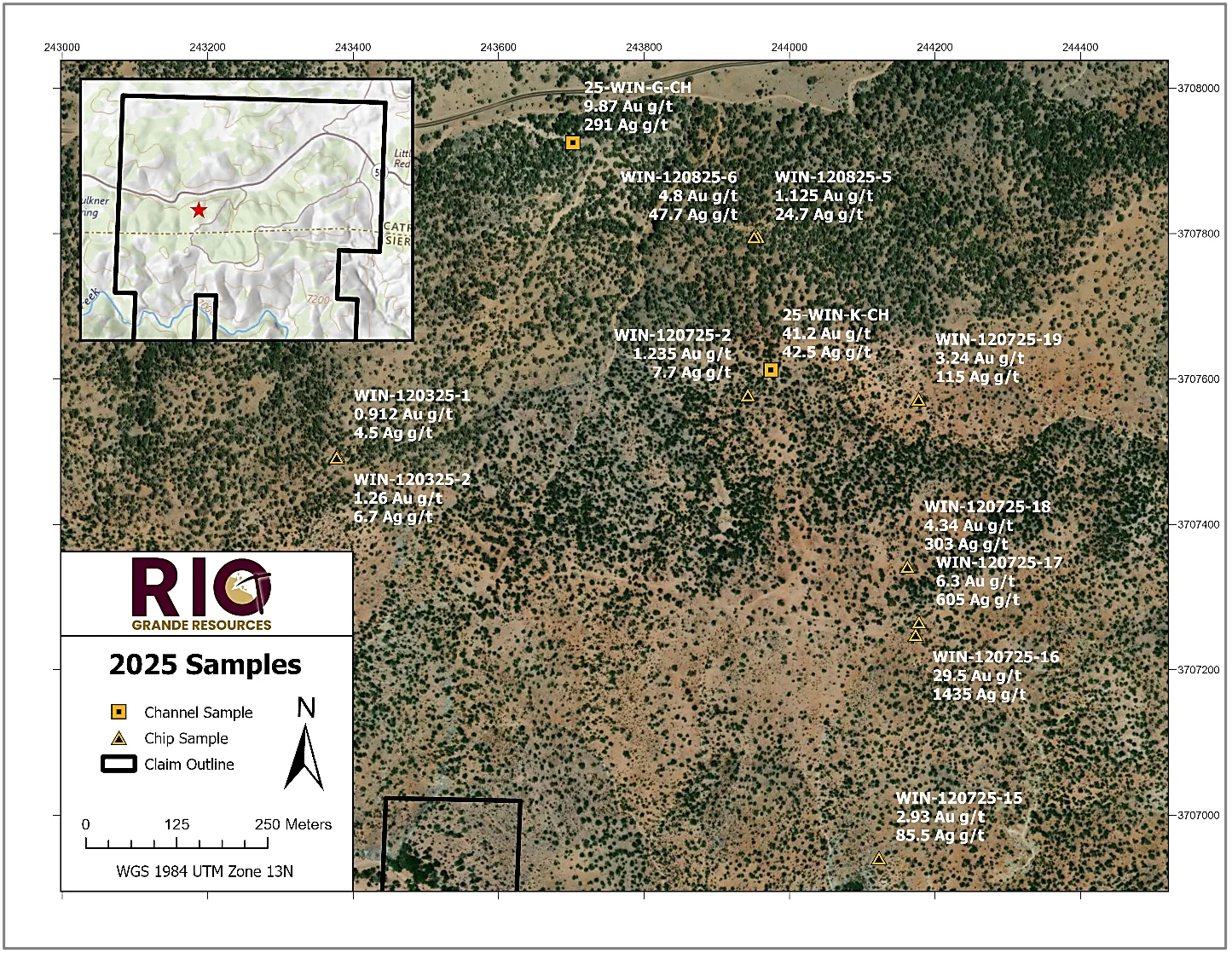
Subsequent exploration results announced on February 19, 2026, further expanded the scale of the system, returning assays of up to 41.2 g/t gold and 1,435 g/t silver from the Poverty Creek area, 46.1 g/t gold and 517 g/t silver from the Emporia area, and 26.8 g/t gold and 1,670 g/t silver from the Little Granite area (see figure 2). These results demonstrated the presence of high-grade mineralization across multiple target areas throughout the property.  The broader relationship between Poverty Creek, Ivanhoe-Emporia, and Little Granite within the Winston claim block is illustrated in Figure 3.

Highlight Results

AreaGold (g/t)Silver (g/t)News Release
Paymaster Corridor66.2830June 18, 2025
Poverty Creek41.21,435February 19, 2026
Emporia46.1517February 19, 2026
Little Granite26.81,670February 19, 2026

For complete assay tables and sampling methodologies, please refer to the Company’s news releases dated June 18, 2025 and February 19, 2026.

Figure 2. High-Grade Sample Location Map
Figure 3. Major target areas identified across the Winston Project, including Poverty Creek, Ivanhoe-Emporia, and Little Granite. Exploration programs completed during 2025 and 2026 returned high-grade gold and silver values from multiple areas across the claim block

District-Scale Potential Emerging

The distribution of these high-grade results, combined with geological mapping and structural analysis completed during the 2025 and 2026 field programs, has contributed significantly to the Company’s evolving understanding of the Winston Project as a potentially connected district-scale low-sulfidation epithermal gold-silver system.

Results from the Company’s December 2025 and May 2026 exploration programs significantly enhanced Rio Grande’s understanding of the structural controls on mineralization throughout the Winston Project. Collectively, the programs identified multiple mineralized vein systems, documented historical workings, and refined several priority target areas, including Poverty Creek, Highway 59, Ivanhoe-Emporia, and Little Granite.

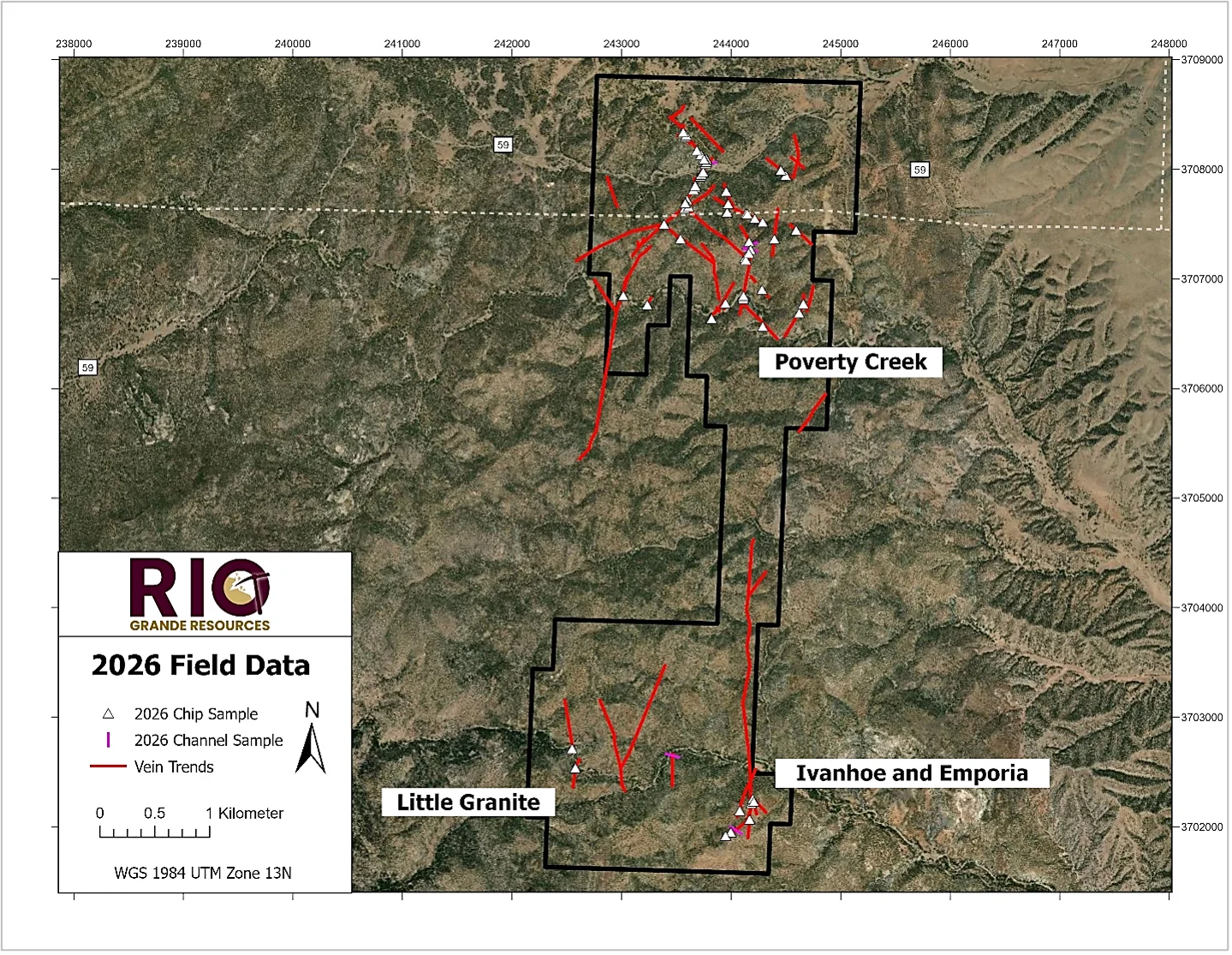
The Phase 2 exploration program, announced on May 21, 2026, included 75 rock chip samples and 5 channel samples, representing 91 individual samples, together with 307 new structural data points. The structural dataset significantly enhanced the Company’s understanding of mineralized vein trends and interpreted corridors throughout the claim block.

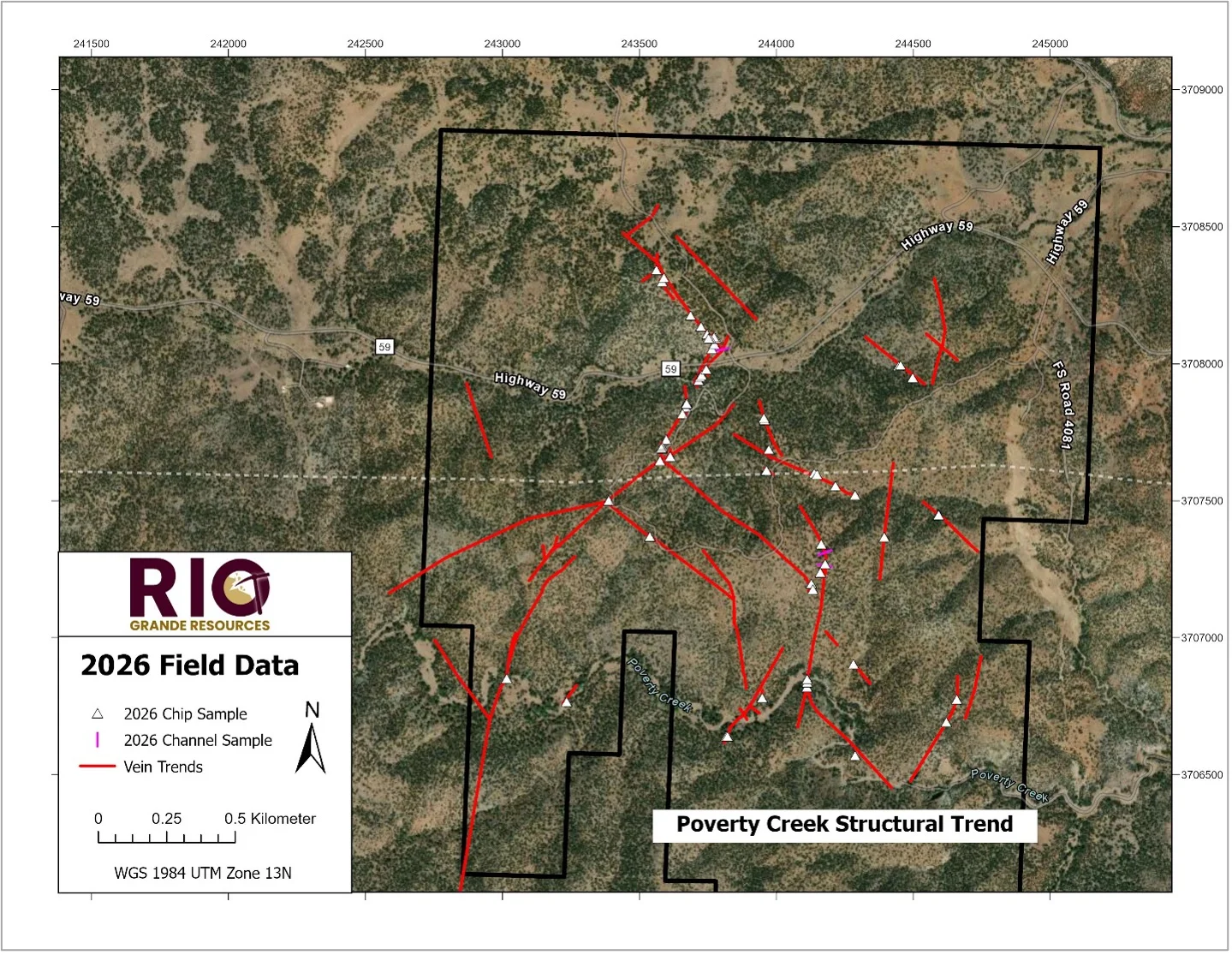
Mapping completed to date increasingly supports the interpretation that Winston may represent a connected district-scale low-sulfidation epithermal gold-silver system rather than a series of isolated vein occurrences. Multiple steeply dipping vein corridors, including vein swarms with several structural intersection points, were identified during the program. These features are considered important exploration targets because they may represent favorable pathways for hydrothermal fluid flow and precious-metal deposition (see Figure 4).

Figure 4. Property map showing 2026 sample points and vein trends. Vein trends are interpreted using field data collected during the December 2025 and May 2026 exploration programs.

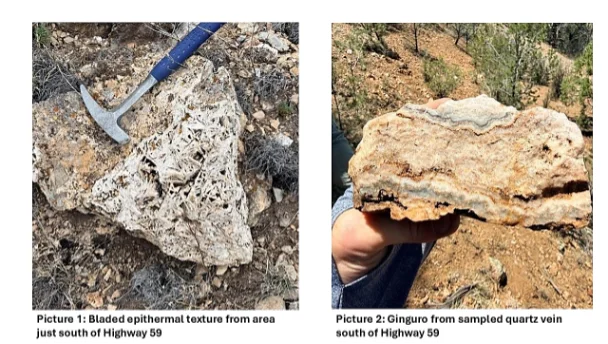
Throughout the property, textures typical of a low-sulfidation epithermal system, including bladed quartz, drusy quartz, comb quartz, amethyst, colloform banding, and vuggy textures, were identified within structurally controlled vein systems.
Pictures 1 and 2. Examples of epithermal quartz textures observed during the May 2026 field program, including bladed quartz and ginguro-style mineral banding. These textures are commonly associated with productive low-sulfidation epithermal gold-silver systems

Advancing Toward a Phase 1 Drill Program

The integration of historical data, surface sampling results, structural mapping, and geophysical interpretations has enabled the Company to refine and prioritize several high-confidence target areas for future drill testing. The identification of multiple mineralized vein corridors, structural intersections, and widespread epithermal textures continues to support the Company’s interpretation that Winston may represent a connected district-scale low-sulfidation epithermal gold-silver system.

Rio Grande remains focused on advancing the Winston Project through the integration of pending assay results from the May 2026 field program and the continued refinement of priority drill targets in preparation for the Company’s planned Phase 1 drill program. The Company believes the combination of high-grade surface mineralization, expanding structural understanding, and multiple target corridors provides a compelling foundation for future drill testing and continued value creation for shareholders.

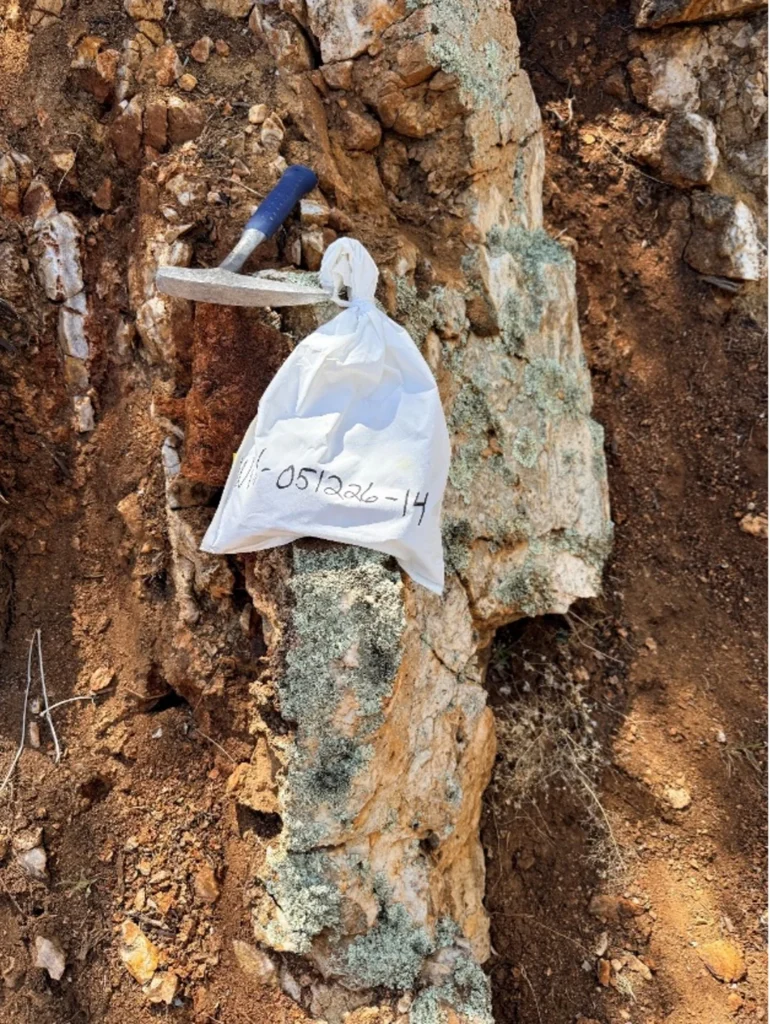
Picture 3. In Situ quartz vein exposure exhibiting classic epithermal textures and mineral banding. Sample WIN-051226-14

Past Exploration

2021 Winston Property Sampling and Exploration

Michael Feinstein, CPG, QP, has visited the Winston Project area on ten separate occasions since October 2020 where he conducted confirmatory sampling of known historic mines, and prospecting in areas away from these occurrences. All samples were collected under his direct supervision of and securely transported to the Tucson laboratory of the ALS Global for analysis. The results confirmed the presence of high-grade material at all three historic mines, as well as in some locations away from these areas.

This program was deemed great success, producing numerous high-grade samples including 41.5 g/t gold and 4,610 g/t silver from newly staked claims (see sampling highlights in table 2 below). Exploration efforts have systemically assessed the northern portion of the Chloride District, which had previously not undergone any modern exploration techniques. Additional samples from these three mines returned peak values of 66.5 g/t gold and 2,940 g/t silver from Little Granite, 26.8 g/t gold and 1,670 g/t silver from Ivanhoe, and 46.1 g/t gold and 517 g/t silver from Emporia. For the full results of the sampling program please review table 3 below.

MineGrams per Ton GoldGrams per Ton Silver
Little Granite66.52,940
Ivanhoe26.8940
Emporia44.9517
Prospecting Best41.5610


Table 3. Highest Grade Samples from Each Mine.

The 155 samples across the project included gold values range from below detection (BD; <0.02 for Au) to a maximum of 66.5g/t, and silver values range from below detection (BD;<0.02 for Ag) to a maximum of 4,610 g/t Ag. Some of the exceptional results from property-wide confirmatory sampling include:

Measured width highlights
  • 3.35 g/t Au with 245 g/t Ag from a 0.3m channel sample inside the Little Granite Decline.
  • 1.97 g/t Au with 232 g/t Ag from a 0.3m channel sample across JAP vein at LG mine.
  • 29.2 g/t Au with 462 g/t Ag from a 0.6m continuous chip sample in north zone.
  • 3.2 g/t Au with 34 g/t Ag from a 1.0m continuous chip sample in north zone
  • 0.75 g/t Au with 489 g/t Ag from a 0.3m continuous chip sample in north zone.
  • Sample 1671079 collected at a prospect pit in recently staked ground returned 41.5 g/t Au with 4,610.0 g/t Ag.
  • Samples 1671021, 1671024, 1671027 were collected from the same vein trend over 300m of strike
  • Sample 1671021 returned 20.6 g/t Au with 21.0 g/t Ag.
  • Sample1671024 returned 12.3 g/t Au with 381.0 g/t Ag.
  • Sample 671027 returned 5.7 g/t Au with 254.0 g/t Ag.
SAMPLE #COMMENTMINEG/T GOLDG/T SILVER
1670958Sugary white quartz w patches of black sulphidesEmporia46.10366.0
1670959Amethyst vein and breccia w minor oxidesEmporia0.021.0
1670960Banded vein w some red zones and minor ginguroEmporia44.90517.0
1670957Banded comb quartz w calcite, oxides, dark gray zonesIvanhoe0.38563.0
1670976Sugary quartz/adularia/calcite banded vein w black sulphide bands, up to 20% locallyIvanhoe4.821,670.0
1670977Layered comb amethyst w oxides and replacement texturesIvanhoe0.023.8
1670978Massive dark gray quartz w red oxide zone, some copper oxideIvanhoe2.91628.0
1670979Calcite breccia w chalcopyrite, included banded vein clastIvanhoe0.47383.0
1670980Layered chalcedony w black sulphide, minor calciteIvanhoe26.80940.0
1670981Qtz/adularia vein w green mustard oxideIvanhoe1.30849.0
1670962Comb amethyst/sugary quartz w red-orange oxidesL Granite3.33218.0
1670963Coarse comb quartz w calcite and bright green crystalline oxideL Granite7.97189.0
1670964Dark grey mucky quartz vein phase, red-orange oxides with trace copper oxideL Granite6.43525.0
1670990Comb quartz with red and black sulphide layers, rare variety on this dumpL Granite0.41690.0
1670992Quartz with red-oxide fluffL Granite0.107.6
1670993Qtz/adularia vein phase w minor orange oxidesL Granite2.15163.0
1670994White banded coarse comb vein, dump backgroundL Granite7.00337.0
1670995Select high grade ore grab at LG haul towerL Granite66.502,940.0
Table 4. displays the ore characterization of the samples collected from historic mine dumps (none omitted).

Numerous ore-shoots have been confirmed on the Winston Project from historic workings. Exploration and geological mapping has identified additional structural zones displaying ore shoot quartz texture indications consistent with mineralization throughout the district. The Little Granite, Ivanhoe and Emporia properties experienced sporadic technical work throughout the 20th century, primarily focused on milling and metallurgy, with the most recent work conducted by Foremost Clean Energy through from 2021 to 2023.

History

Overview of the Chloride Sub-District Mining History

The Chloride Sub-District, initially known as the Apache District, experienced significant mining activity starting in 1880 after the discovery of silver. However, a major decline in silver prices in 1892 led to many mines shutting down. There was a temporary resurgence of exploration and production in the 1920s, but renewed interest in gold and silver in the 1980s, particularly from Getchell Gold, led to the establishment of the St. Cloud Mining Company. Although individual mining veins were explored, a comprehensive exploration of the entire district has yet to be conducted.

Mining mainly took place from 1882 to 1893, significantly affected by the “Great Silver Panic” of 1893. In the 1970s and 1980s, various major and minor companies engaged in exploration and mining, with notable operations in the northern part of the district, such as the Emporia and Ivanhoe Mines. Mining activities declined due to falling gold and silver prices, rather than a lack of mineral resources. Historical assessments suggest that valuable un-mined mineral deposits still exist in the area.

The first silver mineralization in what became the Chloride area was discovered in 1879, focusing on rich silver-gold veins. Among the earliest claims staked were the Ivanhoe/Emporia Claims. The first silver discovery in the Chloride area was made in 1879, and over 400 prospects and mines were developed by 1934. The highest production periods were between 1886 and 1893, contributing to a total output of approximately 6.3 million ounces of silver from Sierra County by 1931.

In 1984, a drilling program revealed promising vein materials, although specific details about the drilling process and quality assurance measures remain unclear. Despite the uncertainty surrounding these historical results, they indicate the potential for valuable mineral resources still present in the district.

World-Class Geological Setting

Rio Grande Rift – Proven Mineral Province

The Winston Project shares key characteristics with the world’s most productive epithermal systems.

Key Geological Features
  • 25km Paymaster Fault – Major structural control corridor
  • 26.5 million-year mineralization – Contemporaneous with Creede district
  • Low-sulphidation epithermal – Well-understood, high-grade model
  • Multiple host rocks – Rhyolite, andesite, limestone breccias

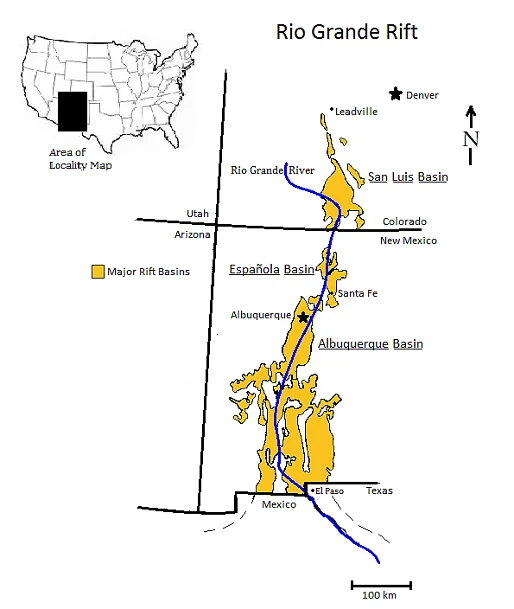
It is located along the west flank of the Rio Grande Rift. This rift, which extends from Colorado to Mexico, features unique geological characteristics and a history of gold and silver of mining activities. The rift has experienced extensive volcanism and hydrothermal processes, which create favorable conditions for the concentration of precious metals. As a result, epithermal and mesothermal deposits have formed, where mineral-rich fluids from the Earth’s interior interact with surrounding rocks, leading to the precipitation of gold and silver. Furthermore, the complex faulting and fracturing within the rift have facilitated the movement of mineral-laden fluids, increasing the likelihood of discovering economically viable concentrations of these metals in various locations along the rift.

Scoring Matrix Visualization

The Benchmarks for Winston

The scoring matrix benchmarks Winston against world-class deposits such as Midas (Nevada) and Hishikari (Japan) across seven geological factors. Winston matches these systems on gold and silver grades as well as structural setting, confirming strong potential. Its lower scores in preservation and maturity reflect the project’s early stage, which is precisely where the upside lies—future drilling could unlock continuity, scale, and significant value growth.
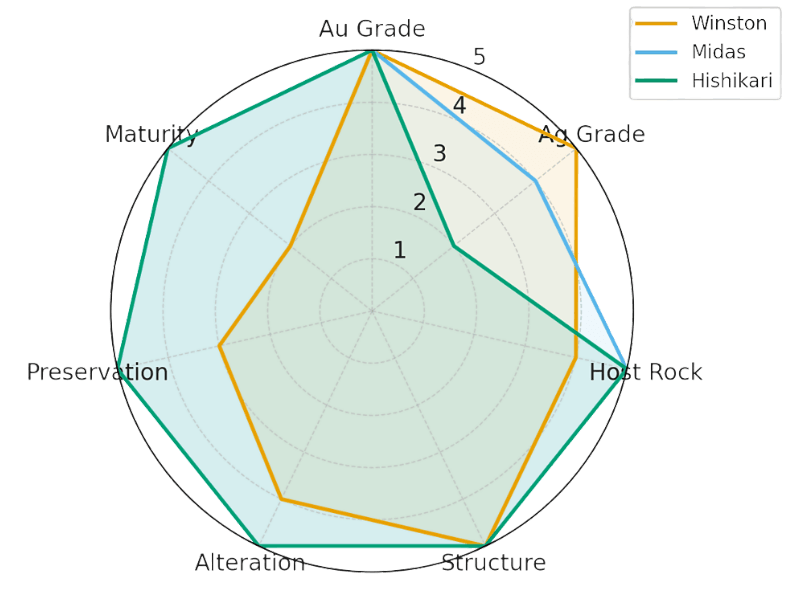
Score Potential:

  1. Au Grade Potential (1–5)
  2. Ag Grade Potential (1–5)
  3. Host Rock Favorability (1–5)
  4. Structural Setting (1–5)
  5. Alteration / Textures (1–5)
  6. Preservation Level (1–5)
  7. Exploration Maturity (1–5)

Max score = 35 (7 factors × 5)

Score Comparability:
Winston (28/35): High grade & structure, early-stage maturity.

Midas (34/35): Textbook world-class bonanza system.

Hishikari (32/35): Bonanza gold, excellent preservation.


Takeaway: Winston matches world-class systems on grade & structure representing a high-potential, early-stage exploration company with drill ready targets.

Conclusion

The most recent sampling program, along with multiple site visits, confirms that earlier reports of high-grade silver and gold values from historic workings are legitimate and justify the need for a major exploration program at the Winston Property. Modern methods should be employed to define the nature and extent of mineralization. Winston represents a rare opportunity to invest in a high-grade, validated gold-silver system before major drilling catalysts. With grades matching producing mines, a proven geological setting, and a clear path to value creation, the project offers exceptional discovery upside at an early-stage valuation.